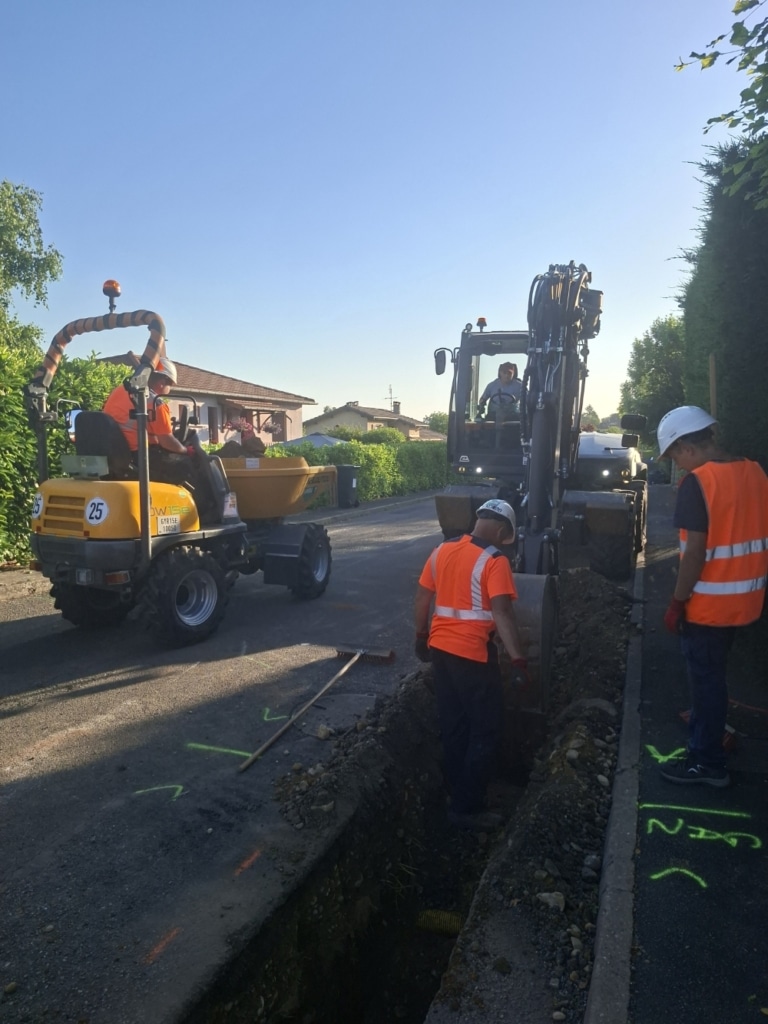
Road construction techniques have long been synonymous with environmental degradation. By this we mean the sealing of soil through asphalt paving, which generates noise and traps heat. Today, new methods make it possible to better protect the environment, road users, and employees’ working conditions. The Mornant region serves as a prime example.
We are in Saint-André-la-Côte, in the heart of the Monts du Lyonnais. The road is beautiful—and for good reason! It was recently repaved. On October 2, after a month of work, MGB completed the road resurfacing project.

Perspective of Laurent Podiacheff, COPAMO’s Road Maintenance Manager
“This project is part of our efforts to preserve our infrastructure heritage. This severely deteriorated road is, in fact, the only access route to the GAEC de la Villardière. Its repair was intended to ensure the safety of road users, as well as the smooth continuation of the farm’s operations. The MGB teams carried out a comprehensive project, including the installation of drainage ditches to manage stormwater. The low-temperature pavement material used is fully in line with our environmental policy. In fact, last November, Copamo signed a departmental charter committing all stakeholders in the Rhône’s mobility infrastructure to the ecological transition. This pilot project, in a sense, foreshadowed these new provisions.”
Explanations by Mucahit Ozer, environmental engineer at MGB Travaux Publics
“By producing this type of low-calorie asphalt mix, we have prevented the release of 3.2 metric tons of CO₂ equivalent—a 9% reduction in greenhouse gas emissions compared to a traditional construction project. In addition, the lower temperature makes it easier for workers to handle the material with scrapers or shovels, as the heat is less intense. This practice is in line with our environmental policy: we plan to significantly increase the number of construction sites that incorporate these more environmentally friendly methods.”